Blog: Agentic AI, Explained

Editor-in-Chief

A plain-language guide for behavioral health teams
Somewhere today, a Utilization Review coordinator is working through seven chart tabs to find the three sentences that justify another five days of care. Down the hall, a front desk lead is chasing the same incomplete intake packet for the second time this week.
You’ve likely already seen how AI can help in day-to-day care delivery, through things like summarizing charts, drafting notes, or responding to questions.
Agentic AI is the next step. It takes on work like that before anyone opens it. The name gets used loosely, so this guide pins down what it means, how it differs from the AI your team already uses, where it can give people hours back, and where it may not belong.
The short version
Agentic AI is software you hand a goal, not a prompt. It plans the steps, works through them using the records and tools it’s authorized to use, checks its own progress, and brings the finished work to a person for review.
The underlying concept to focus on here is delegation. You delegate a defined piece of work, the system does it, and you stay accountable for the result.
Three things that get called “AI” (and how to tell them apart)
Automation: rules do the work.
- Same input, same output, every time.
- Example: “Send a reminder text 24 hours before every appointment.”
- Reliable, but blind to anything the rule didn’t anticipate.
Assistive (generative) AI: you ask, it answers.
- Drafts, summarizes, explains when prompted.
- Example: “Summarize this chart.” “Draft this group note.”
- You gather the information, steer every step, and carry the workflow forward.
Agentic AI: you set direction, it does the work.
- Starts on its own when a trigger is met (a review coming due, an intake left incomplete).
- Finds and organizes what’s relevant, coordinates several steps, adapts when something is missing.
- Example: ““Monitor upcoming deadlines and prepare every continued-stay review before it’s due.
- You review, correct, and approve. The agent carries the workflow; you’re at the helm.
A useful way to hold the distinction: assistive AI helps your team finish a task. Agentic AI moves the work forward before anyone opens it.
In practice: utilization review
Every few days, a UR specialist has to make the case to a payer that a patient still needs their current level of care. Today that means tracking the deadline, digging through 5 to 7 chart tabs, finding the evidence, mapping it to criteria like ASAM or LOCUS, drafting the narrative, and completing the payer’s form: roughly 30 minutes per review, and one missed review can put $6,000 to $15,000 in authorized days at risk.
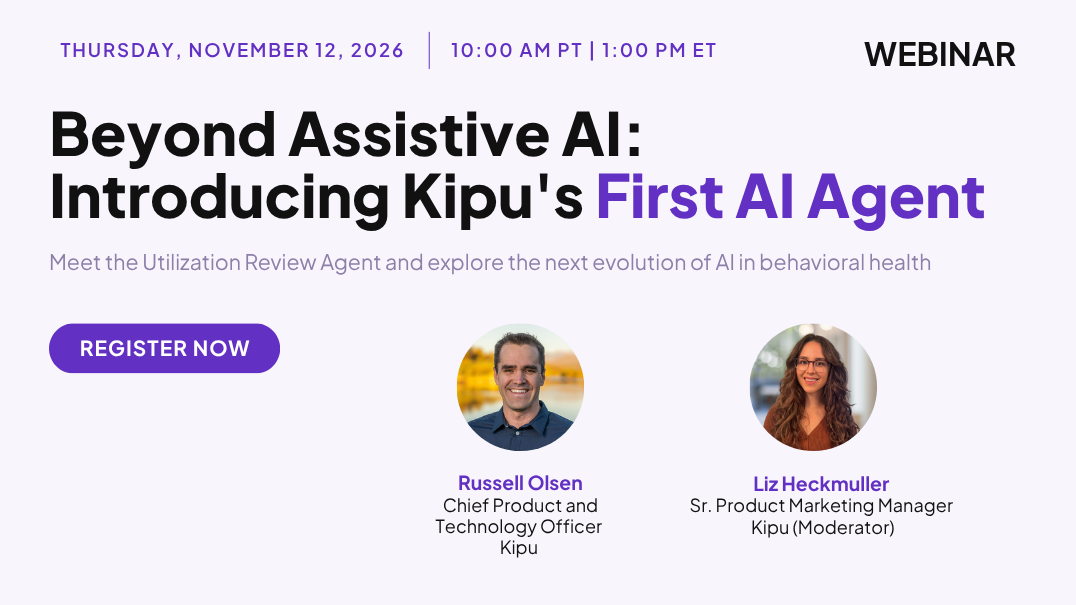
An agentic approach runs that prep before the shift starts: reviews queued by due date, the record analyzed, evidence and gaps surfaced, the case and cover letter drafted with sources cited. The specialist opens a prepared review, validates and edits it, and submits. Kipu’s Utilization Review Agent, now available in Kipu Helix, is built on this model: the agent handles the prep, the person stays in control.
Five tests for whether something is really “agentic”
The label gets applied to a lot of chat windows. A system should pass all five before it fits.
- Goal-directed. It receives an objective, not just a request to generate text.
- Multistep. It carries out connected steps using authorized information and tools.
- Adaptive. It checks progress and changes course, rather than following a script.
- Bounded. Its access and actions are limited, with explicit rules for approval and escalation.
- Observable. You can see what it understood, what it did, what it couldn’t finish, and you can stop or correct it.
These tests let you see past the demo. The first three tell you whether a system is doing work on its own or just answering questions through a nicer interface, and the last two tell you whether it can be trusted in a clinical setting.
An answer versus a finished piece of work
Picture a patient leaving a program who needs follow-up care.
An assistive tool might: draft a continuing-care plan, list questions for the referral partner, and compose an appointment reminder. Good, useful output that needs someone to act on it.
An agentic workflow could: check the discharge record and referral requirements, flag what’s missing, search approved referral resources, present options to a coordinator, request approval, send the referral, confirm it went through, and route anything still stuck to the right person.
The difference matters because a referral only helps once the patient gets care, and there is a long distance between a well-written letter and a completed handoff. The letter has to be sent, the sending confirmed, the confirmation turned into an appointment someone keeps. Those gaps are where follow-through can break down, and where agentic AI is built to carry the work the rest of the way.
Why it benefits the behavioral health community
- The people doing this work are stretched thin. Your teams carry heavy administrative loads on top of clinical ones, and burnout follows. Taking repetitive prep off their desks makes room for the human-centered work they came into the field to do.
- So much of the work repeats on a clock. Concurrent reviews come due every 3 to 7 days, intake packets need follow-up, referrals need chasing, and audits need prep. Work that recurs on a schedule, draws on the record, and follows known steps is exactly what a goal-directed system can take on, leaving people free for the parts that need their judgment.
- Consistency shouldn’t depend on who’s on shift. Experienced reviewers know where to look in a chart and what to pull forward. An agent gives every reviewer that same starting point, so a strong case doesn’t hinge on who was working that day or how much else was competing for their attention.
- The information usually already exists, but it might be scattered across notes, tabs, and systems. Agentic AI is good at the finding and assembling, which is where staff productivity most often hits a bottleneck.
Where it tends to help first
The strongest early use cases are coordination and preparation, not clinical decisions.
- Utilization review prep: tracking deadlines, pulling evidence, mapping it to medical necessity criteria, drafting the case.
- Intake coordination: spotting incomplete packets and following up before a person has to.
- Referral follow-through: identifying referrals that stall and routing the barrier.
- Chart audit and compliance: finding documentation gaps while there’s time to fix them.
What stays with qualified humans: diagnosis, treatment changes, medication decisions, discharge decisions, and crisis disposition. Drafting a recommendation is not the same as the authority to make it.
Why you might not be ready for it yet
Agentic AI is a tool with a specific shape, and while it can deliver amazing benefits to your staff, clients, and business, it won’t fit every organization or every workflow. Before deciding to adopt, ask yourself the following:
- Do you have a bounded, repeatable workflow to hand it? If the work is mostly one-off judgment calls, an agent adds overhead without taking much off anyone’s plate.
- Is your documentation ready for it? An agent assembles evidence from the record. If the record is thin or inconsistent, it will surface that quickly, and the fix is a documentation project, not an AI one.
- Do you have someone who owns the escalation? “Human in the loop” means little unless someone is named, response times are set, and after-hours coverage exists.
- Have privacy obligations been mapped? HIPAA and, for substance use records, 42 CFR Part 2 govern what an agent can access and share. That takes a compliance review, not an assumption.
The bottom line
Agentic AI pursues a goal through actions.
Assistive AI produces content when asked.
Automation follows rules.
Beyond that distinction, three things are worth remembering:
- The value is in delegating bounded, repeatable work your team does by hand today, especially finding and assembling information that already lives in the chart.
- The safeguards belong in the definition itself: limited access, approval gates, visible progress, a named human on the other end.
- Start with coordination and preparation, keep clinical authority with clinicians, and measure success by work that actually gets done.
The technology is moving from AI that answers to AI that acts. The question for your organization is simpler than the hype suggests: what work could your team safely hand off, and what would they do with the time?
See agentic AI in action with Kipu.
Kipu’s new Utilization Review Agent, built on Kipu Helix, helps behavioral health teams proactively prepare reviews, organize clinical evidence, and identify documentation gaps, giving specialists more time to focus on advocating for continued care.
Request a demo
About the Authors


Rely on Kipu to keep you ahead of change.
Subscribe to Kipu for behavioral health news, updates, community celebration, and product announcements.